Yes. The XPENG G6 fits Australian road use well when the trip pattern includes city commuting, motorway travel and regular regional driving. The Australian New G6 offers up to 525 km WLTP range, an 80.8 kWh LFP battery in Long Range and Performance versions, and DC charging of up to 451 kW. XPENG states that 10–80% charging can take 12 minutes under suitable conditions. The G6 also carries a five-star 2024 ANCAP rating, with 88% Adult Occupant Protection and 86% Child Occupant Protection. Its 571-litre boot, 5.8-metre turning radius and 475 kg maximum payload make it practical beyond commuting.
Australian driving places very different demands on one vehicle within the same week. A commuter may spend Monday travelling at 40–80 km/h through suburban traffic, then use 100–110 km/h roads for several hours on Saturday. Range therefore needs to be considered alongside energy use, charging availability, tyre size, vehicle mass and sustained highway speed rather than as one laboratory number.
The Australian New G6 range provides three configurations. The RWD Standard Range uses a 68.5 kWh gross LFP battery, while the RWD Long Range and AWD Performance use 80.8 kWh packs. The Long Range is rated at 525 km WLTP, while the Performance reaches 510 km on 20-inch wheels. XPENG lists combined consumption of 17.9 kWh/100 km for the Long Range and 18.4 kWh/100 km for the Performance.
| Australian G6 version | Battery | WLTP range | Power / torque | 0–100 km/h |
|---|---|---|---|---|
| RWD Standard Range | 68.5 kWh | up to 480 km* | 185 kW / 440 Nm | about 6.9 sec |
| RWD Long Range | 80.8 kWh | 525 km | 218 kW / 440 Nm | 6.7 sec |
| AWD Performance | 80.8 kWh | 510 km | 358 kW / 660 Nm | 4.13 sec |
*Range varies with wheel specification and current Australian configuration. XPENG advises that WLTP figures are comparative test values; temperature, speed, air-conditioning, gradient and load can reduce real road range. That distinction matters more once a route leaves metropolitan areas, because charging locations can be farther apart than they are around Sydney, Melbourne or Brisbane.
A 525 km WLTP rating should therefore not be treated as 525 km of guaranteed motorway travel. At higher speed, aerodynamic resistance rises substantially, while cabin cooling during a hot Australian afternoon adds electrical demand. Carrying four adults and luggage also increases energy use. A driver planning a 400 km regional trip would normally leave a reserve rather than schedule arrival at 1–2% battery.
That reserve becomes less restrictive when charging stops are short. The Long Range and AWD Performance accept up to 451 kW DC charging, while XPENG quotes 12 minutes for 10–80% charging when charger output, battery temperature and other conditions allow it. A 10–80% session on an 80.8 kWh gross battery represents a large portion of the stored energy being replenished during one stop.
A 451 kW vehicle rating does not make every public charger a 451 kW charger. A 150 kW unit will remain limited by its own output, and battery temperature or state of charge can also reduce power.
That distinction is useful when comparing suv cars australia, because peak charging capability matters most when the route includes compatible high-output stations. The G6 uses a full-domain 800V architecture, giving it greater charging headroom than vehicles designed around lower-voltage systems. XPENG's Australian material also specifies CCS2, the connector commonly used by Australian DC charging networks.
Home charging covers a different part of ownership. The Long Range and Performance support 11 kW AC charging, with XPENG listing about 9.2 hours from 5% to 100%. A driver covering 50 km per weekday would travel about 250 km across five working days, less than half the 525 km WLTP rating of the Long Range before accounting for real-world differences.
Charging is only one part of long-distance suitability, because an SUV also has to remain stable and manageable when the road surface changes. Australian sealed roads can move from smooth urban asphalt to coarse-chip regional surfaces, patched lanes and repeated expansion joints. The G6 uses front double-wishbone suspension, while published G6 technical material lists a multi-link independent rear arrangement.
Vehicle dimensions provide more context. The G6 measures about 4,758 mm long, 1,920 mm wide and 1,650 mm high, with a 2,890 mm wheelbase. Despite its width, the listed turning radius is 5.8 metres. That figure matters in shopping-centre ramps, apartment parking areas and older urban streets where a large SUV may require repeated steering corrections.
Mass is harder to ignore. The RWD Long Range has a listed kerb weight of 2,115 kg, while the AWD Performance reaches about 2,220 kg. Its extra 105 kg accompanies a second motor and much higher output. The Performance produces 358 kW and 660 Nm compared with 218 kW and 440 Nm from the Long Range, yet both have a listed 202 km/h maximum speed.
For normal Australian motorway use, the difference is more noticeable in acceleration than top speed. The Long Range reaches 100 km/h in 6.7 seconds, while the Performance does it in 4.13 seconds, roughly 38% quicker by elapsed time. Drivers who mainly travel on dry sealed roads may find the rear-wheel-drive version sufficient, while AWD adds traction capability when road conditions are wet or loose.
Performance also affects energy consumption. The 18.4 kWh/100 km WLTP figure for the AWD model is about 2.8% higher than the Long Range's 17.9 kWh/100 km. Over 20,000 km, those official figures correspond to roughly 3,680 kWh versus 3,580 kWh, before real-world temperature, speed and charging losses are considered.
Safety performance is easier to compare because ANCAP publishes separate assessment categories. The G6 was tested under the 2024 ANCAP protocols and received five stars. ANCAP reports 35.49 points out of 40, or 88%, for Adult Occupant Protection and 42.62 out of 49, or 86%, for Child Occupant Protection.
The same assessment gave the vehicle 81% for Vulnerable Road User Protection and 80% for Safety Assist. Standard equipment covered by ANCAP includes autonomous emergency braking for car, pedestrian and cyclist situations, lane-keep assistance, lane-departure warning, emergency lane keeping and advanced speed assistance. The Australian rating applies to all listed G6 variants from October 2024 onward.
ANCAP's published test set includes a 50 km/h frontal offset test, a 50 km/h full-width frontal test, a 60 km/h side-impact test and a 32 km/h oblique pole test, so the five-star result is based on several crash configurations rather than one impact type.
Passenger protection leads naturally to family usability. The G6 seats five and provides 571 litres of luggage space behind the second row. Folding the rear seats increases capacity to 1,374 litres, about 141% more volume than the normal boot configuration. Published specifications also list a 923 mm luggage-opening width, giving bulky suitcases and sports equipment a relatively broad loading path.
Payload capacity deserves equal attention on a family trip. The RWD Long Range is rated for up to 475 kg of payload, while the Australian Performance specification lists 470 kg. Four occupants averaging 75 kg each would account for 300 kg, leaving about 175 kg in the Long Range for luggage and other carried items before reaching the stated payload figure.
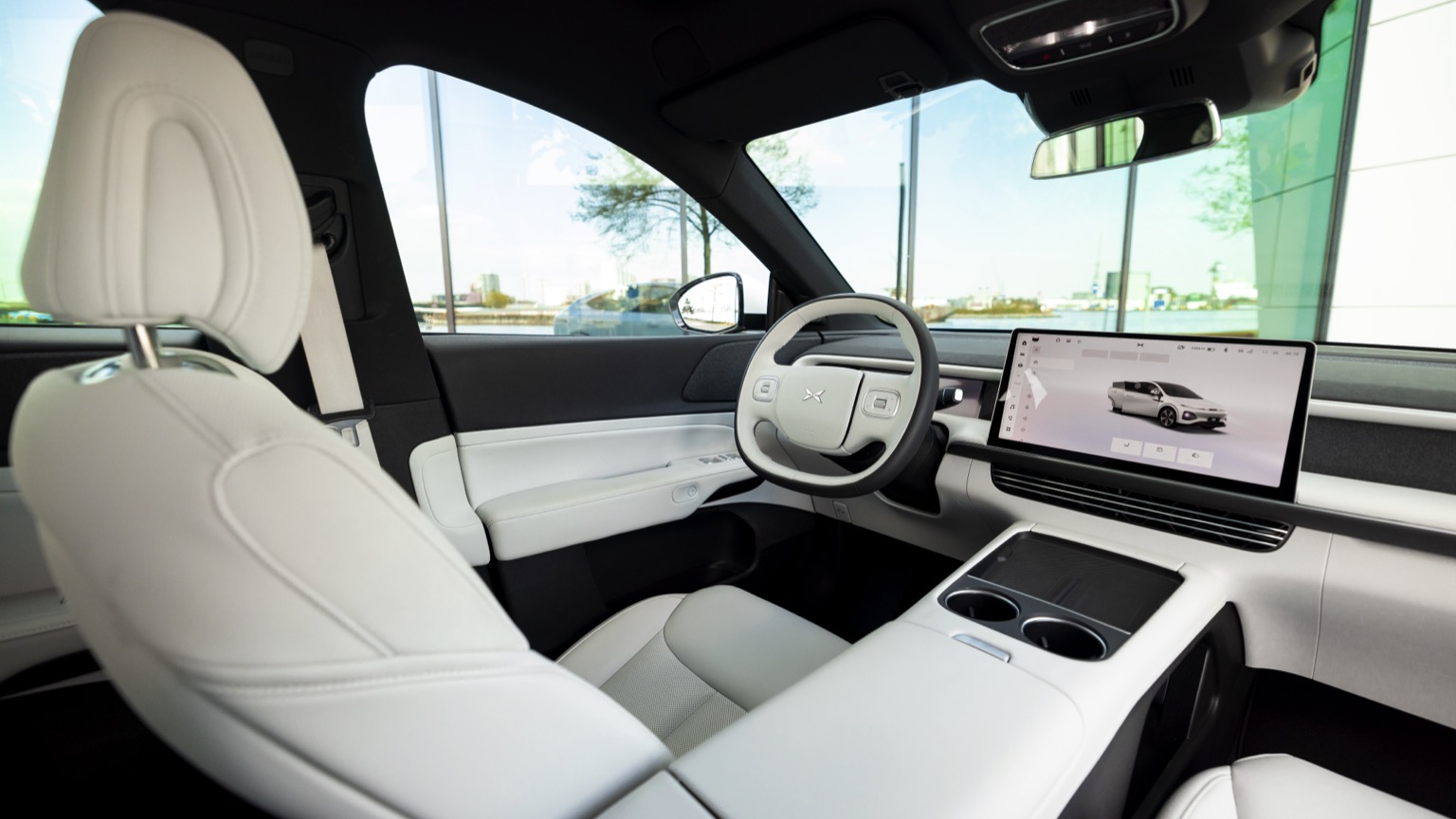
The cabin adds two main displays rather than relying entirely on one screen: a 10.25-inch digital instrument panel and a 15.6-inch centre touchscreen. Apple CarPlay and Android Auto are supported, alongside navigation, voice control and over-the-air software updates. Seven airbags are listed in the Australian configuration, while rear ISOFIX points support normal family-seat installation requirements.
Practicality extends outside the cabin through Vehicle-to-Load capability. XPENG lists up to 6 kW V2L output on the Long Range and Performance versions. For camping or outdoor use, that is enough rated output to run several moderate-power electrical devices, although the total connected demand must remain within the system limit and battery energy used externally reduces remaining driving range.
For mostly urban use, the Standard Range keeps battery capacity and vehicle mass lower while retaining fast DC charging. For drivers regularly covering regional routes, the 525 km Long Range offers the broadest distance rating without moving to the heavier AWD powertrain. The Performance trades some efficiency for 358 kW, 660 Nm and a 4.13-second 0–100 km/h time.
For Australian sealed roads, all three versions have specifications suited to everyday use rather than only short-distance EV commuting. The strongest numerical case sits with the Long Range: 525 km WLTP, 451 kW maximum DC charging, 571 litres of boot capacity, 475 kg payload, 218 kW output and a five-star 2024 ANCAP rating. Buyers travelling far beyond major charging corridors still need to check charger location and output before departure, because infrastructure can place a tighter limit on a regional EV trip than the G6 itself.