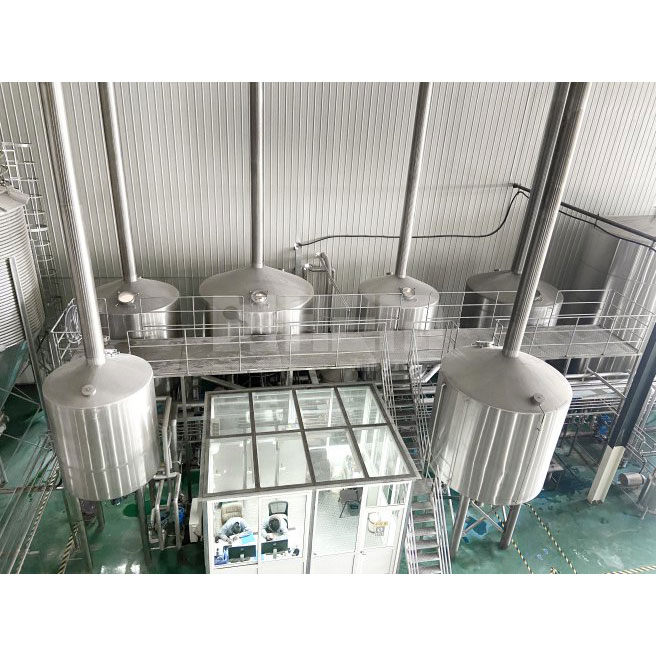
Commercial beer brewing equipment usually costs $50,000 to $500,000 for a small or midsize brewery, while larger production breweries can spend $1 million or more. A 3–5 BBL setup may fall near $30,000–$100,000, while a 10–20 BBL brewery with fermenters, glycol cooling, pumps, controls, and packaging equipment often reaches $150,000–$500,000. One U.S. beer barrel equals 31 gallons, so a 10 BBL batch produces about 310 gallons before process losses. Equipment price depends heavily on brewhouse size, fermentation capacity, automation, heating method, packaging speed, installation work, and how many batches the brewery plans to produce each week.
Brewhouse size is only the first number to examine. A 5 BBL brewhouse holds roughly 155 gallons per batch, while a 10 BBL system handles about 310 gallons and a 20 BBL system about 620 gallons. The Brewers Association uses 31 U.S. gallons as one barrel, so annual production planning can be translated into actual liquid volume rather than relying on tank names alone. A brewery producing two 10 BBL batches per brewing day can theoretically send about 620 gallons to the cellar before losses, making fermentation capacity the next expense to calculate.
Fermenters often account for more total stainless-steel capacity than the brewhouse because wort may leave the brewhouse within hours but remain inside a fermenter for 10–21 days or longer. A brewery running a 10 BBL brewhouse three times per week produces 30 BBL weekly; with a 14-day average tank cycle, it may need at least 60 BBL of active fermentation space before allowing room for cleaning, scheduling, or slower beers. That production pattern is why a brewery with one 10 BBL brewhouse may purchase six, eight, or more fermentation vessels.
| Typical system | Common business use | Approximate equipment range |
|---|---|---|
| 1–3 BBL | Pilot brewery, nano brewery | $20,000–$60,000 |
| 3–5 BBL | Small taproom, brewpub | $30,000–$100,000 |
| 7–10 BBL | Microbrewery, larger brewpub | $70,000–$200,000 |
| 15–20 BBL | Small production brewery | $150,000–$500,000 |
| 30–50 BBL | Regional production operation | $300,000–$1,000,000+ |
| 50+ BBL | Higher-volume production | $500,000–$2,000,000+ |
Those ranges can overlap because two breweries with a 10 BBL brewhouse may purchase very different systems. A basic two-vessel manual brewhouse needs fewer valves, pumps, instruments, and controls than a four-vessel automated installation designed for several turns per day. In 2025, U.S. craft brewers produced about 22.0 million barrels, down 4% from 2024, while 60% of reporting breweries recorded lower production and 39% recorded growth. Spending for unused capacity therefore deserves as much attention as buying too little equipment.
A two-vessel brewhouse commonly combines mash and lauter functions in one vessel and kettle and whirlpool functions in another. Moving to three or four vessels separates more process stages, allowing the next mash to start before the previous batch completes every stage. That layout adds stainless steel, platforms, pumps, pipework, motors, and controls, but it can support multiple batches during one brewing shift. A brewery planning one batch every two days has little reason to specify the same brewhouse configuration as a plant expecting three or four batches during an 8–12 hour production day.
A craft brewery system also needs hot-water storage, wort cooling, pumps, hoses or hard piping, cleaning equipment, fermentation temperature control, and enough electrical or gas capacity to operate them together. A quoted brewhouse price of $80,000 can therefore represent only part of a $150,000–$250,000 equipment package once six fermenters, one or two brite tanks, a glycol chiller, sanitary fittings, controls, and cleaning equipment are included. Comparing suppliers by total equipment scope gives a more useful number than comparing the brewhouse vessel price alone.
Heating choice changes both equipment and building costs. Electric heating can suit smaller systems because it avoids a steam boiler, but a larger electric brewhouse may require substantial three-phase electrical service. Direct-fired kettles require burner controls, fuel supply, exhaust, and suitable ventilation. Steam-heated systems add a boiler, steam piping, condensate return, water treatment, and installation work, yet they remain common in larger commercial breweries because several vessels can share the steam source. A 2025 facility assessment should therefore include available electrical amperage, gas service, mechanical-room space, and local inspection requirements before a brewhouse is ordered.
Cooling deserves similar treatment because fermenters must reject heat during fermentation and may later require rapid temperature reduction. A small glycol package may cost roughly $5,000–$15,000, while larger multi-tank systems can reach $20,000–$50,000 or more. Chiller capacity should include simultaneous demand rather than only the volume of one tank. If six 10 BBL fermenters are installed in year one and another four are planned for year three, sizing the piping and main distribution loop for 10 tanks can cost less than replacing undersized infrastructure after production has started.
Packaging creates another large change in the budget. A taproom selling most beer through draft lines may rely mainly on kegs, while a distribution brewery may need filling, seaming or capping, labeling, coding, conveyors, rinsing, and case-packing equipment. An entry-level semi-automatic canning machine can stay in the tens-of-thousands-of-dollars range, while a faster automated line with supporting equipment can reach well into six figures. In 2025, U.S. craft beer volume declined 4%, but craft still represented 13.4% of U.S. beer volume and 24.8% of retail beer dollars. Packaging investment should therefore follow the brewery's actual sales mix rather than simply copying a larger producer.
Several equipment categories are commonly left out of an early quotation:
-
CIP equipment, sanitary pumps, hoses, clamps, valves, and spare gaskets can add thousands of dollars even in a 5–10 BBL brewery.
-
Water treatment may include sediment filtration, carbon filtration, softening, reverse osmosis, storage, and blending equipment.
-
Air compressors may be needed for pneumatic valves, packaging machines, and other plant equipment.
-
Keg washers range from simple manual stations to automated machines processing dozens of kegs per hour.
-
Laboratory tools for gravity, pH, dissolved oxygen, microbiology, and package quality add another budget category.
-
Freight, rigging, commissioning, and installation can add a significant percentage to the equipment purchase price.
Installation deserves its own allowance because tanks are only useful after they are connected to water, power, gas or steam, drainage, cooling, and process piping. A brewery may also require floor coatings, trench drains, structural work, ventilation, utility upgrades, or a crane to position large vessels. TTB rules require U.S. brewers to maintain operational and inventory records for at least three years, while state and local authorities may impose separate building, zoning, fire, and operating requirements. Equipment layout should therefore be reviewed alongside regulatory and building plans rather than after fabrication.
A 10 BBL brewery provides a useful budgeting example. Assume the owner purchases a $75,000–$130,000 brewhouse, six fermenters for $35,000–$75,000, two brite tanks for $10,000–$25,000, and a $10,000–$25,000 glycol package. Pumps, CIP equipment, fittings, water treatment, and keg equipment could add another $25,000–$60,000. The combined equipment budget reaches roughly $155,000–$315,000 before major building work or a full canning line is considered.
Tank sizing can reduce unnecessary capital spending. A brewery targeting 3,000 BBL per year does not need the same cellar as one targeting 10,000 BBL. At 3,000 BBL, production averages about 58 BBL per week across 52 weeks. On a 10 BBL brewhouse, that is close to six batches each week before losses. If each fermenter remains occupied for about two weeks, more than 120 BBL of fermentation capacity may be needed once scheduling space is included. Buying only four 10 BBL fermenters would leave the brewhouse waiting for empty tanks even though its nominal brewing capacity looks sufficient.
Larger fermenters can lower the number of vessels needed but change the production routine. A 20 BBL fermenter paired with a 10 BBL brewhouse generally requires two brews to fill it, while a 30 BBL tank may require three. Double- or triple-batching reduces tank cost per barrel of cellar capacity but places more demand on the brewhouse during the same day. Labor, cleaning time, heating speed, raw-material handling, and cooling capacity therefore need to be calculated together rather than treating tank volume as an isolated number.
New and used equipment also produce different cost profiles. Used tanks may sell for substantially less than new vessels, but freight, removal, storage, refurbishment, replacement valves, controls, and installation can narrow the difference. A 2018 fermenter in good condition may remain suitable for years, while an older automated brewhouse with discontinued PLC hardware may create more service work than a new manual system. Pressure rating, jacket condition, weld quality, interior finish, electrical compatibility, documentation, and spare-part availability are more useful comparison points than equipment age by itself.
The market environment also supports careful sizing. The Brewers Association reported 9,578 operating U.S. craft breweries in 2025, 2.9% fewer than in 2024; craft production fell 4%, and overall U.S. beer production and imports declined 5.7%. A brewery designed around aggressive volume growth may therefore carry expensive unused capacity, while a smaller brewhouse with room to add fermenters can spread spending across several years.
For purchasing, quotations should use the same specification sheet: vessel working volume, total volume, steel grade, jacket area, insulation thickness, heating method, pump size, motor voltage, fittings, automation level, pressure rating, platform scope, controls, freight terms, commissioning, warranty, and spare parts. If one $120,000 quote includes eight tanks and another $90,000 quote includes four, the 25% lower headline price says little about total installed capacity. A line-by-line comparison shows what the brewery will actually receive and what must still be purchased before the first commercial batch.