A factory-direct purchase can give the buyer a direct commercial relationship with a manufacturer, but it does not remove the need to verify who is contracting, define the product, agree quality and change controls, or plan export and delivery responsibilities. Before paying a deposit, buyers should understand the seller and production site, compare a complete quotation, set written approvals, and identify which logistics and compliance tasks remain with each party.
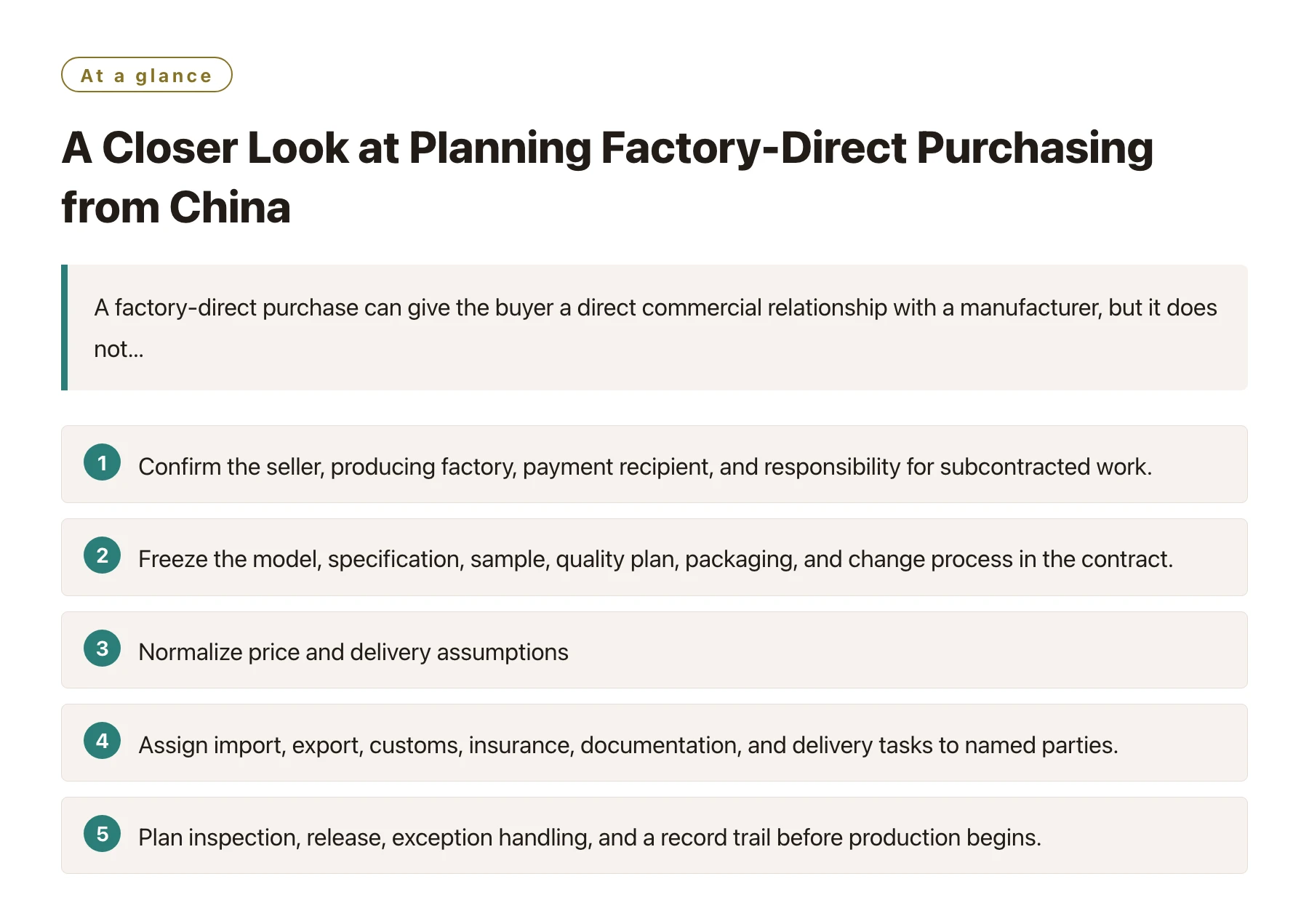
Key takeawaysConfirm the seller, producing factory, payment recipient, and responsibility for subcontracted work. · Freeze the model, specification, sample, quality plan, packaging, and change process in the contract. · Normalize price and delivery assumptions, including tooling, inspection, freight, and exclusions. · Assign import, export, customs, insurance, documentation, and delivery tasks to named parties. · Plan inspection, release, exception handling, and a record trail before production begins.
“Factory-direct” describes a commercial route, not a substitute for supplier qualification or a complete purchasing plan.
Verify what “direct” means in the transaction
Ask which legal entity will sign the contract, issue the invoice, receive funds, manufacture the goods, and manage export. These roles can belong to different organizations. Record the factory’s legal name and address, the seller’s details, any trading or sourcing intermediary, and the production site for the specific order. Do not infer the contracting party from a website or factory tour.
Clarify who performs each process and whether any production is outsourced. Identify responsibility for component sourcing, finishing, assembly, testing, packing, export clearance, and customer communication. If a sales entity manages the factory relationship, establish who will authorize substitutions, resolve nonconformities, and support claims after delivery.
Buyers can View details about sourcing and supplier coordination as they evaluate the model. Whatever route is chosen, independently verify bank details and changes to payment instructions through known contacts. Have procurement and finance review entity names, payment terms, and contractual remedies before funds move.
Build a product specification the factory can quote
Describe use, destination market, product model, materials, dimensions, components, function, finish, accessories, labeling, packaging, quantity, and required date. Mark essential requirements separately from preferences. Provide controlled drawings and revisions, and name the person who answers technical questions. A detailed brief reduces the chance that factory-direct price comparisons are based on different configurations.
Ask the manufacturer to identify what it can produce itself and what it proposes to source externally. Request a bill of materials or equivalent component list for important features. If the factory recommends an alternate material or process, require a separate quotation and an explanation of its effects on performance evidence, appearance, cost, schedule, and maintenance.
Tie the quote to the specification version and request that production cannot begin until the buyer approves the correct sample or pre-production reference. State how the factory will identify the current revision at workstations, how obsolete components are controlled, and how changes are proposed and approved.
Assess capability and quality controls
Review production processes relevant to the product, including equipment, personnel, tooling, assembly steps, testing, packing, and subcontracted operations. Ask how capacity is planned for the requested model and quantity. A factory’s size or product catalogue does not establish that it can reliably make the exact configuration or meet the delivery date.
Ask how materials are inspected, work instructions are controlled, defects are isolated, corrective actions are verified, and traceability is maintained. A management-system certificate may describe a defined quality framework, but it does not by itself prove a particular product meets the buyer’s specification. Request product- and lot-specific evidence for claims that matter to the order.
Agree the sample and inspection process before production. Define sample identity, acceptance criteria, methods, reports, timing, access, and who may release goods. State how the parties will handle a discrepancy: hold, rework, concession, replacement, additional test, or re-inspection. Make clear that the factory’s internal “pass” status does not replace any buyer release decision.
Compare the complete commercial offer
Normalize unit price for model, quantity, materials, finish, accessories, packaging, inspection, sample, tooling, and delivery basis. Separate one-time charges from recurring costs and identify minimum quantities or price tiers. Ask for quote validity and the assumptions behind material costs and production time. A low number may exclude required engineering, packing, or quality work.
Clarify payment stages, deposit, balance due, tooling ownership, sample charges, bank fees, currency, and refund terms. State how changes in quantity, specification, or delivery date affect price. If the seller uses a factory-side or third-party fee, identify who pays it and what deliverable it covers. Keep commercial terms in the contract rather than relying on chat messages.
Specify warranty scope, claim route, evidence required, replacement or repair process, and responsibility for freight on corrective goods. Ask how long spare components will be available if the product requires maintenance. Legal or regulatory terms should be reviewed by the buyer’s qualified counsel or compliance owner for the relevant jurisdiction.
Allocate transport, cost, and risk clearly
Factory-direct buyers still need to decide who arranges pickup, export clearance, freight, insurance, import entry, duties, destination handling, unloading, and final delivery. Incoterms can allocate specified tasks, costs, and risks between seller and buyer; the U.S. International Trade Administration summarizes these responsibilities and recommends stating the selected rule and named place. [1] The chosen term should be written into the contract with a precise location.
Ask whether the factory’s offer is ex-works, delivered to a port, or delivered to a named destination, and identify any services that remain outside the term. Confirm who selects the forwarder, who pays local handling, who obtains insurance, who submits customs data, and who answers a hold or document query. Get route assumptions and package dimensions from the actual order.
Compare factory-arranged freight with buyer-arranged freight only after matching route, transit, service, documentation, and destination costs. Review special handling, dangerous-goods status if applicable, storage, inspection, and demurrage risk with qualified logistics providers. Do not assume direct buying automatically results in the lowest landed cost.
Prepare documents before production and dispatch
The purchase file should include final specification, approved drawings, quotation, purchase order, sample record, change approvals, quality plan, packaging instructions, and required product documents. Assign one source of truth and keep superseded revisions identifiable. The factory should understand which documents are required before production, inspection, shipment release, and destination entry.
Confirm commercial invoice, packing list, transport document, origin details, and product identifiers before handoff. Match seller, buyer, consignee, manufacturer, model, quantity, and packaging across the records. Work with a qualified customs broker to determine classification and required data. Accurate paperwork is an operational control, not a clerical afterthought.
For products subject to destination-market rules, ask the compliance owner to confirm registrations, labels, declarations, test records, or permits before order placement. The applicable obligations depend on product and jurisdiction. Do not treat a factory certificate or an export history as universal approval.
Set a delivery schedule with decision buffers
Work back from the required arrival date through sample review, specification closure, materials, production, inspection, rework allowance, packing, export handoff, transit, import clearance, and final delivery. Ask which milestones depend on buyer input and when capacity is reserved. A factory’s production lead time does not include every step between order and receiving.
Name contacts for engineering, sales, production, quality, finance, and logistics. Agree a status cadence that shows planned date, forecast, actual status, blocker, owner, and decision needed. Define the escalation threshold for a missed date or missing material. Written updates make it easier to distinguish a supplier delay from a late approval or changed requirement.
Decide whether partial shipment is allowed, how the factory will maintain lot or variant identity, and who pays additional freight. Consider whether partial goods are useful at the destination and whether they create installation or inventory problems. Capture the decision before the schedule is under pressure.
Inspect, release, and manage exceptions
Perform agreed checks at the stage that can still reveal meaningful issues. A sample review, in-process visit, pre-shipment inspection, document audit, and receiving check answer different questions. For each, define scope, sample selection, acceptance rules, evidence, and limitations. Retain reports and identify the inspected lot.
Set an authorized shipment-release process. Confirm inspection disposition, unresolved findings, quantity, labels, packing, documents, and transport readiness before goods depart. If a deviation is accepted, record who approved it, which units it covers, and the conditions. A factory’s shipping notice is not the same as the buyer’s release approval.
For delays, shortages, damage, or quality problems, define who contains affected goods, who can communicate with the factory, what evidence is preserved, and how replacement or repair is arranged. Keep photographs, carton identifiers, reports, and correspondence with the order. This trail supports claims and improves the next purchase cycle.
Review the model after the first order
Compare actual cost and delivery with the original quotation and schedule. Record differences by source: specification changes, packaging, inspection, freight, fees, storage, customs, or destination handling. Use final invoices and shipping records to refine the next estimate. Avoid treating an early low estimate as a reliable benchmark for a different quantity or route.
Review received quality, supplier communication, missing parts, packaging condition, and claim response. Tie each observation to model, revision, lot, site, and known handling conditions. Discuss recurring issues with the factory and require evidence of corrective action where needed. Maintain a supplier scorecard that distinguishes objective records from subjective impressions.
Decide what should change in the contract, specification, inspection plan, or service model before repeat ordering. Factory-direct purchasing works best when direct access is accompanied by clear accountability, technical control, and a practical path from production to delivery.
Sources
Frequently asked questions
Does factory-direct purchasing eliminate intermediaries?
It may change the contracting or communication structure, but buyers should verify who sells, manufactures, receives payment, manages subcontractors, and handles export.
Is the factory quote the same as landed cost?
Usually not. Confirm the named delivery point and account for freight, insurance, customs, duties, destination handling, service fees, and excluded charges.
What should be agreed before a factory starts production?
Agree the exact product specification, approved sample, quantity and price, quality checks, packaging, milestone dates, change process, required documents, and shipment-release authority.
Who decides whether a shipment can leave?
The contract should name the buyer’s release authority and the evidence required. Supplier readiness or an inspection report alone may not close every open requirement.