Genre Labels on NSFW AI Sites: What They Signal
A genre label is a promise about the reply, not a rating of quality. When a card is tagged Unfiltered, Submissive, Fictional, OC or Female, the tag tells you which shelf the character belongs to and roughly what kind of exchange to expect, and it says nothing about how well written the character is. Reading labels as categories rather than as recommendations is the skill that turns a crowded board into a shortlist.

Key takeaways
- Labels sort, they do not rank. A tag such as Fictional or OC describes provenance; a tag such as Submissive describes interaction style.
- The trends board lists 20 entries tagged with a small vocabulary, and the Crushon chart is rewritten every Thursday, so labels move with the list.
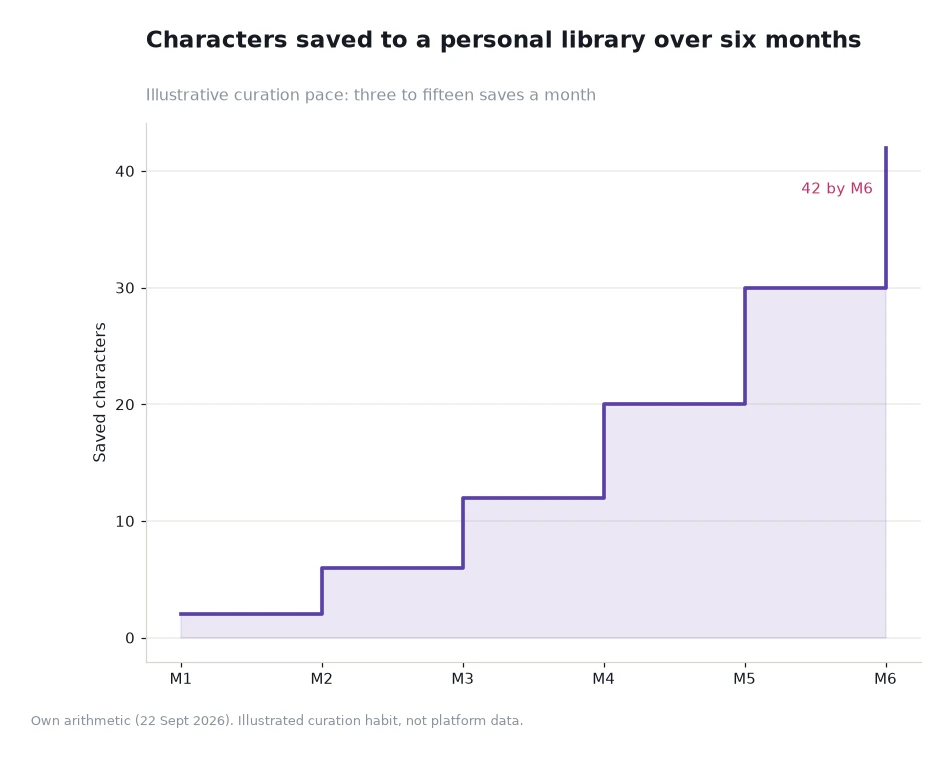
- Illustrative curation: a reader saving 2, 6, 12, 20, 30 and 42 characters across six months has 42 saved entries by month six.
- Filter labels — Unfiltered, Filtered and 18+ — narrow the whole catalogue before any personality tag is applied.
A label describes a shelf, not a standard
The mistake readers make is treating a label as a mark of approval. It is closer to the sign above an aisle: useful for navigation, silent on whether any individual item is good. Two characters tagged the same way can be wildly different in execution, and two characters with completely different tags can both be excellent.
Labels also do most of their work before a conversation starts. They set the register a reader expects, which shapes the opening message, which in turn shapes the reply. A reader who opens a Fictional character expecting a modern setting and writes accordingly gets a different conversation from one who opens an OC entry expecting a specific backstory.
The practical rule is to use labels to filter, then use the description to choose. Filtering happens on a whole catalogue; choosing happens one card at a time, which is where the two counters on each card become useful.
The four kinds of label you will meet
Sorting the vocabulary into four kinds makes a large catalogue legible. Filter labels decide what you see. Personality labels describe interaction style. Provenance labels say where a character comes from. Format labels describe presentation rather than behaviour.
Keeping the kinds apart prevents a common confusion. Unfiltered and Filtered are not personality traits; they are views of the catalogue. Submissive is not a statement about content provenance. Fictional and OC are not interaction styles. Once the kinds are separated, a card's tag row reads as a short specification.
| Kind | Examples | What it tells you |
|---|---|---|
| Filter | Unfiltered, Filtered, 18+ | Which view of the catalogue you are browsing and which entries appear |
| Personality | Submissive and similar style tags | The register a reply is likely to adopt |
| Provenance | Fictional, OC | That the character is invented rather than drawn from elsewhere |
| Format | Animated | How the entry is presented, not how it behaves in conversation |
| Demographic | Female and the gender filter | A coarse sort that removes most of the board in one click |
Worked example: labels and the shape of a library
Consider an illustrative reader who keeps only what matches a label they have decided to follow. Their cumulative saves could run 2, then 6, then 12, then 20, then 30, then 42 across six months. Read as increments, the row rises by 4, 6, 8, 10 and 12, and the totals confirm the curve: 2 plus 4 is 6, plus 6 is 12, plus 8 is 20, plus 10 is 30, plus 12 is 42.
Now attach a label to the pattern. If two thirds of those 42 entries carry the same personality tag, that is 28 characters kept on the strength of one label decision. Twenty-eight out of forty-two is about 67 percent, which shows how much of a library can be determined by a filter set once and never revisited.
That is the argument for reviewing labels rather than just using them. A reader who spends six months inside one tag has built a library with a narrow shape, and the fix is not to delete entries but to browse a different filter for one session and add three characters from outside the usual shelf. The curve above is an illustrated habit, not platform data.
Where the labels are published
Labels appear in three places, and each deserves a different kind of attention. The character search page lists trending tags, so it shows what other readers are opening at the moment you look. The weekly rankings refresh every Thursday and show which entries held attention long enough to keep a place. And the tag list published alongside the nsfw ai chat chart attaches labels to 20 entries at a time.
Read together, those three surfaces also show how quickly a label vocabulary turns over. A tag attached to several of the top NSFW AI characters this week may be absent from the board next week, while the stable filters — Unfiltered, Filtered and 18+ — stay where they are. Follow the stable labels and treat the fast-moving ones as fashion rather than as categories.
One further signal is easy to miss. Cards carry a creator credit beneath the description, and creators tend to work inside a narrow set of genres. Finding two entries you like from the same creator is often faster than reading twenty tag rows, because the second choice has already been narrowed by the first.
Reading all three gives a fuller picture than any one of them. Trending tags are noise-tolerant and move fast. Rankings reward persistence. Card tags are the stable vocabulary you actually filter with, and they are the ones worth learning properly.
One habit makes the vocabulary usable: write down the two or three tags that produced characters you kept. After a month you have a personal taxonomy of perhaps five labels, which is far more useful than scrolling the unfiltered catalogue and choosing by artwork.
Frequently asked questions
Do labels guarantee a particular style of conversation?
No. They set expectations and bias the register, and the reply still depends on the description, your opening message and the character's remembered context.
Why do the same tags appear on cards that feel very different?
Because a label covers a broad shelf. Two entries can share a style tag and differ in setting, backstory and vocabulary, which is why the description still matters after filtering.
Should I filter to Unfiltered and stay there?
Only if that is genuinely what you want. The Filtered and 18+ views exist to narrow a large catalogue, and switching between them is the cheapest way to see entries your usual filter hides.
Learn five labels properly
Pick five labels, read what each one means on the catalogue pages rather than guessing from the word, and use only those for a fortnight. You will browse faster, open better-matched characters, and stop mistaking novelty for fit.
Then expand deliberately, one label at a time, and review the result monthly. Labels are the cheapest tool on any character site and the one most readers use without reading, which is exactly why a small vocabulary used carefully beats a large one used loosely.
Data and sources: tag vocabulary and the 20-character weekly chart on the trends board[1], trending tags and the Thursday ranking schedule on the search page, plus the filter set used across the catalogue. Counters and pages were read on 22 Sept 2026; save-curve figures are worked examples, not platform measurements. Intended for an adult audience of 18+; read 22 Sept 2026.