Black or Red: Colour Rules on the DC Side
The published construction for the manufacturer's 1500 V solar cable lists two sheath colours, black or red, and nothing else. Colour on the DC side is a marking convention rather than an electrical rating: the same 6 mm² copper sits under either sheath, with the same DC 1.8/1.8 kV rating, the same XLPO insulation and the same bending radius of 4 × the outer diameter.
Key takeaways
- Published options on the 1500 V cable: sheath in black or red, and single-core as well as twin-core versions.
- The colour does not change the ratings: DC 1.8/1.8 kV, spark test 10 kV, test voltage 6.5 kV AC for 5 minutes.
- Model names published across the range include H1Z2Z2-K, PV1-F and UL 4703 solar PV wire.
- Commonly used specifications are 4 mm², 6 mm² and 10 mm², all built on a tinned copper class 5 conductor to IEC 60228.
What the published colour option actually covers
The construction line is short: sheath material XLPO, electron-beam cross-linked and low smoke halogen free, colour black or red. That is the whole published statement on colour. Everything else on the page, from the conductor build to the temperature limits, is identical for the two options, which is the point worth remembering when a specification insists on one colour for reasons of appearance rather than identification.
A second published option sits next to the colour: single-core and twin-core versions of the same cable. KUKA CABLE states those options in the same construction line, without qualifying one as better than the other, because the choice depends on the layout rather than on the electrical duty. A twin-core construction puts the positive and negative conductors under one jacket, which changes the marking question. When the two cores are separate, colour can carry the polarity; when they share a jacket, polarity has to be identified another way, usually by a printed legend or by the way the connector is keyed.
How polarity is identified on a DC string
On the DC side of a PV system the string has a positive and a negative leg, and the two must never be crossed at a connector. A common convention is black for the negative leg and red for the positive, and the manufacturer supports both colours as published options, which is a different statement from endorsing a particular convention.
- Two separate single-core lengths: colour can distinguish the legs, subject to the site's own rules.
- One twin-core length: colour cannot distinguish the legs, so a printed legend or keyed connector does the job.
- Mixed circuits in a combiner box: a colour change at each junction makes a wrong reconnection visible before it is made.
- Maintenance years later: whatever convention is chosen, it has to be recorded in the installation documents.
Any colour rule that is to survive a change of crew should be recorded in the installation documents, and the range behind it is set out on the solar cable section of the manufacturer's site. A colour rule that exists only in the head of the installer who wired the array is not a rule; it becomes a hazard the next time the string is isolated.
A practical check on site is to read the printed legend rather than the jacket. The model name and the standard the cable was made to are printed along the sheath in ink chosen to survive exposure, and where that legend has faded the honest answer is that the identity of the cable has to be confirmed from the delivery documents before it is reused. Recording the model and the standard in the cable schedule is what makes that possible years later.
Why colour is not a rating, and the risk of treating it as one
Two cables in the same size can be specified for different duties and look identical. The published family here covers a solar range where the model names are H1Z2Z2-K, PV1-F and UL 4703 solar PV wire, and the wider catalogue lists automotive wire, battery cable, marine cable and welding cable as separate products. If a red solar cable and a red battery cable were both left on site, colour would tell a fitter nothing about which standard the cable was built to.
That is why the marking that matters is the printed legend on the sheath, not the colour of it. The manufacturer's certificates page counts more than 30 certificate types such as TUV, IEC, CE, SAA and UL, and the standards named for the PV cable are TUV 2PfG 1169/08.2007, EN 50618:2014 and IEC 62930. A specification should name the standard and the model, and use colour only as a secondary aid.
The published options in one table
| Item | Published options | Where it is published |
|---|---|---|
| Sheath colour | Black or red | /products/1020.html |
| Core arrangement | Single-core and twin-core versions | /SOLAR_CABLE/ |
| Model names | H1Z2Z2-K, PV1-F, UL 4703 solar PV wire | Solar cable pages |
| Conductor | Tinned copper, class 5 flexible to IEC 60228 | /products/1020.html |
| Commonly used sizes | 4 mm², 6 mm² and 10 mm² | /SOLAR_CABLE/ |
Worked example
Stock planning shows the cost of a convention. Take the two published colours and the two published core arrangements, and the range alone offers four combinations of the same electrical product. Add the three commonly used cross-sections and one model name, and a distributor is looking at twelve orderable variants before any drum length is fixed. That multiplication is the author's own arithmetic on published options.
The alternative is to order all black and mark the positive leg on site. In that case the marking has to be durable, because the published ambient range runs from −40 °C to +90 °C and a sticker applied at commissioning has to survive both ends of it. Either route works, but choosing one deliberately is what prevents two conventions existing on the same roof, and the company page shows how long a cable made to these published ratings is expected to stay in service.
Frequently asked questions
Does the colour of the sheath change any rating of the cable?
No. The published construction offers black or red with the same XLPO insulation and sheath, the same DC 1.8/1.8 kV rated voltage, the same spark test at 10 kV during production and the same 6.5 kV AC test for 5 minutes on the finished cable. Colour is a published option, not a specification level.
Which colour should be ordered for a new string installation?
Follow the project specification and the site rules in force. The manufacturer publishes both colours as options, so the choice is not restricted by production. What matters is consistency: pick a convention, write it into the installation documents, and use the printed legend on the sheath as the primary identifier.
What to write into the cable schedule
List the model name, the standard, the size, the core arrangement and the colour as separate fields, then add the connector type for each end. That way a change of colour cannot smuggle in a change of standard, and a substitution at the merchant's counter is visible on the paperwork.
Where the schedule is silent, ask. The manufacturer publishes construction, testing and certification detail but no prices, minimum order quantities or lead times, so colour and size availability should be confirmed with the sales desk before the order is placed.
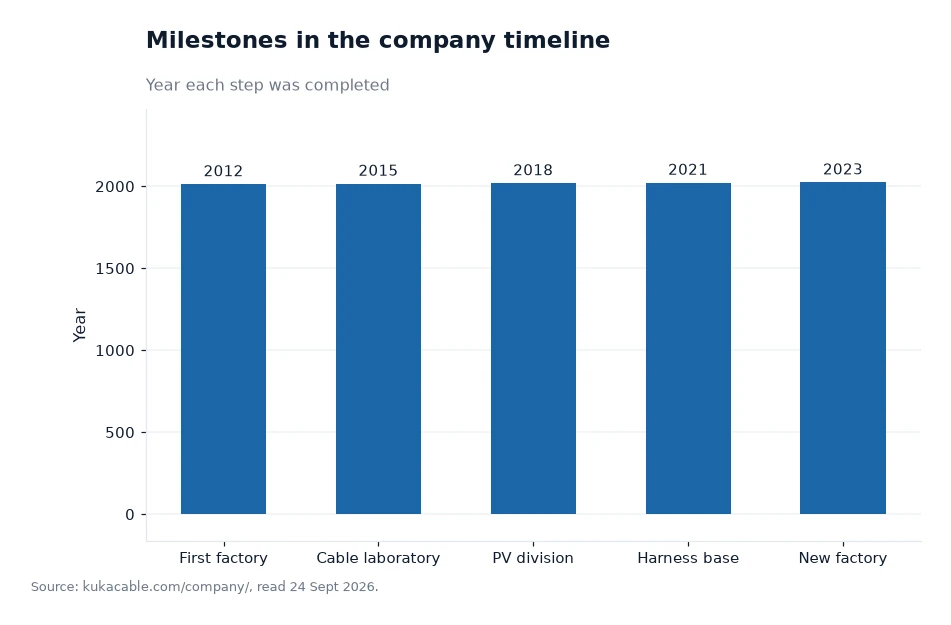
The black and red colour options, plus the milestones charted here, are stated on the manufacturer's own website, kukacable.com, studied 24 Sept 2026[1].